Wednesday, June 30, 2010

Panasonic G2 Commercial Apparently Shot with a Canon 5D Mark II

So why would a commercial for Panasonic's Lumix G2 camera touting it's ability to shoot 720p HD be shot with the Canon 5D Mark II?

I think maybe the PR department is kicking itself for releasing this behind-the-scenes video of the making of the commercial. Watch and you'll see the Canon being used in many of the scenes.

Why would they not use their own camera?


I wonder just how much of the commercial was actually shot on a Lumix? Another camera, the GoPro Hero is used in a very creative way. They attached it on an extension to the baseplate of the Lumix creating a great visual effect as the actor moves while holding the G2 in his hand. Very cool!

Sunday, June 27, 2010

"My first thought is always of light"


The above quote by the late Galen Rowell inspires me each and every time I go out to shoot. Without light, there is no photo. Galen always managed to find beautiful light.

Galen Rowell was a wildlife photographer and naturalist whose work was often compared with Ansel Adams. Rowell began his photography career with National Geographic in 1973 - about the same time I started my career in photojournalism. He offered readers a visually dynamic style of photography that other photographers could not get because not only was Galen a great shooter, but an athlete and mountaineer. He could hike and run for miles with his camera and often did, climbing mountains the rest of us just looked up at. Rowell considered himself to be a participant in his compositions, as opposed to just being an observer. He felt that an integral part of enjoying his photography was appreciating the skill it took to achieve his specific point of view. This separated his images from looking like something "that was taken from the side of the road."

I met Galen many years ago while on assignment for the SF Chronicle. We were both shooting a peregrine falcon nest on the slopes of Mt. Diablo in the San Francisco bay area. Only difference was, Galen was up close and personal with the nest due to his climbing skills. I was shooting from the ground below with a long telephoto. Needless to say, Galen had an incredible set of images for National Geographic magazine. Mine were only so-so!

If you enjoy landscape and adventure photography, check out some of Galen's books. He'll inspire you with his images and the stories behind them. Also if you are ever in Bishop, California, stop by and visit the Mountain Light Gallery where Galen's photos are on display. Galen lived in Bishop when he passed away in an unfortunate plane crash. He set up the gallery in an old, beautiful bank building in town and I make it a point to stop by each time I visit the area. His work is always inspiring as are his words.

Check out a few of his inspiring quotes :
A lot of people think that when you have grand scenery, such as you have in Yosemite, that photography must be easy.

And most of my early pictures failed but about one in a 100 somehow looked better than what I saw.

Ever since the 1860s when photographers travelled the American West and brought photographs of scenic wonders back to the people on the East Coast of America we have had a North American tradition of landscape photography used for the environment.

I almost never set out to photograph a landscape, nor do I think of my camera as a means of recording a mountain or an animal unless I absolutely need a 'record shot'. My first thought is always of light.

I began taking pictures in the natural world to be able to show people what I was experiencing when I climbed and explored in Yosemite in the High Sierra.

I began to realise that film sees the world differently than the human eye, and that sometimes those differences can make a photograph more powerful than what you actually observed.

I find it some of the hardest photography and the most challenging photography I've ever done. It's a real challenge to work with the natural features and the natural light.

I like to feel that all my best photographs had strong personal visions and that a photograph that doesn't have a personal vision or doesn't communicate emotion fails.

I remember when an editor at the National Geographic promised to run about a dozen of my landscape pictures from a story on the John Muir trail as an essay, but when the group of editors got together, someone said that my pictures looked like postcards.

I think landscape photography in general is somewhat undervalued.

I think that cognitive scientists would support the view that our visual system does not directly represent what is out there in the world and that our brain constructs a lot of the imagery that we believe we are seeing.

I'm exchanging molecules every 30 days with the natural world and in a spiritual sense I know I am a part of it and take my photographs from that emotional feeling within me, rather than from an emotional distance as a spectator.

If we limit our vision to the real world, we will forever be fighting on the minus side of things, working only to make our photographs equal to what we see out there, but no better.

Luckily, many other people tell me how they have had a particular landscape photograph of mine in their office or bedroom for 15 years and it always speaks to them strongly whenever they see it.

My first thought is always of light.

My mountaineering skills are not important to my best photographs, but they do add a component to my work that is definitely a bit different than that of most photographers.

One of the biggest mistakes a photographer can make is to look at the real world and cling to the vain hope that next time his film will somehow bear a closer resemblance to it.

The combination of pictures and words together can be really effective, and I began to realise in my career that unless I wrote my own words, then my message was diluted.

The landscape is like being there with a powerful personality and I'm searching for just the right angles to make that portrait come across as meaningfully as possible.

The reason that I keep writing is that all my most powerful messages about the fates of wild places that I care about need to have words as well as images.

There is no question that photography has played a major role in the environmental movement.

There's no question that photographs communicate more instantly and powerfully than words do, but if you want to communicate a complex concept clearly, you need words, too.

These days, most nature photographers are deeply committed to the environmental message.

Wanting to take a light camera with me when I climb or do mountain runs has kept me using exclusively 35 mm.

What I mean by photographing as a participant rather than observer is that I'm not only involved directly with some of the activities that I photograph, such as mountain climbing, but even when I'm not I have the philosophy that my mind and body are part of the natural world.

When we tune in to an especially human way of viewing the landscape powerfully, it resonates with an audience.


Top photo : Split rock and cloud © Galen Rowell/Mountain Light
Above photo of Galen next to Yosemite Falls : © Ron Kauk/Mountain Light

A special thank you to Barbara Laughon of the Mountain Light Gallery for permission to run both photos.

Friday, June 25, 2010

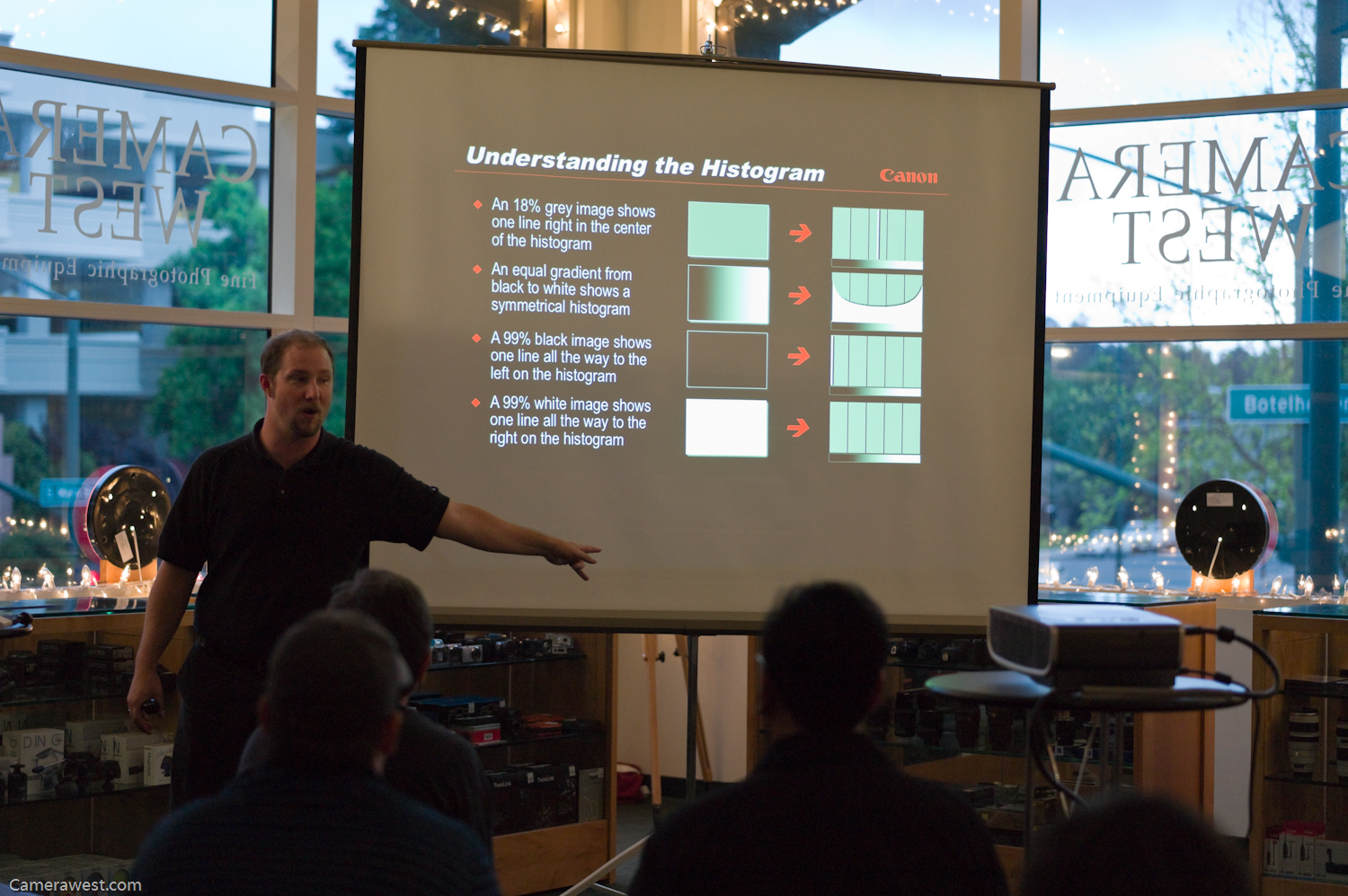
Canon Demonstration Presentation


June 25th, 2010

Last night, Camera West, Walnut Creek played host to Canon's regional technical educator, Adam Passman for a fantastic presentation on Canon D-SLR basics.  Thanks to everyone who attended - It was a pleasure having you here.  Adam will return soon for presentations on some more advanced topics.  You can stay tuned via the events calendar on our blog www.camerawestblog.com.

Sincerely,

Camera West.

Wednesday, June 23, 2010

Flying With Your Camera Gear

School is out, summer is here and many of you are packing your photo gear for a well deserved vacation. How do you securely pack all of that gear when flying?

Traveling with expensive, delicate photography equipment has always been a challenge. When I was traveling on out of town assignments for the SF Chronicle, I would try to carry on board with me all my equipment - both camera and computer. I did that for 2 reasons. First to make sure it didn't get lost, and secondly, to make sure it didn't get damaged. Depending on the assignment, it sometimes was impossible to carry it all with me so I had to resort to checking in some of it as luggage. I emphasize "some" because I always carried with me what I considered was the bare minimum to shoot my assignment. If all my luggage got lost or delayed, I could at least still complete my assignment.

For example, during the football season, I often traveled out of town to cover a 49er or Raider game. My long lens of choice for football changed depending on how I wanted to shoot that particular game and whether it was a night or day game. Even the weather played a role in my lens choice. But for most games, it was a 400mm 2.8. That alone weighs a hefty 12 pounds but I always tried to carry it on board with me along with 2 motorized bodies, a 70-200mm zoom and a 16-35mm zoom. Also with me was my laptop computer and all of it's accessories. I never really weighed all of this - probably because my back really didn't want to know - but it was well beyond the 40 lb maximum carry-on weight limit. It all fit in an rolling case that did meet the size restrictions but certainly not the maximum weight restrictions. When it came time to board the aircraft, I always smiled and pretended like the bag was feather light - even when lifting it to the overhead bins. Did not want to tip off the flight attendants that I had with me an 60 lb carry on!

Another trick to consider is that you can carry a lot of your gear in your pockets when you board. That's where those all those pockets in photo vests really come in handy. Just stuff them all up with gear...the flight attendants can't stop you from doing that - you'll look a little silly - but at least you'll know the gear will arrive safely with you to your destination.

Anyway, all of this always worked for me in my travels. (Not the vest part...I didn't care to look that silly!) Although I've had luggage delayed, I never had gear lost or not been able to shoot my assignment due to damaged gear. I didn't want to have to explain to my editors why I could not shoot my assignment.

And speaking of damaged gear, If you must check in some of your equipment, I highly recommend a hard plastic case, lined with foam or well insulated with what I preferred to use, my clothing for the trip. Rather than take up valuable space with foam, just use your clothes. I always used Pelican cases. They are well made, and have multiple latches to keep the lid closed and the contents safe from spilling out. Keep in mind however that you cannot lock your cases. They must be unlocked at all times for TSA inspectors.

And that leads me to a final tip that I've never tried but it will insure that your bag can be visually checked, locked, never opened again by the TSA or anyone else while in transit, and be delivered via ’special handling’ to your destination.

There is a little known rule in place by the TSA that allows a passenger to check an unloaded firearm in a securely locked hard-sided case. This rule applies to something as simple as a ’starter pistol’ that requires no permit for you to own. If you slip a simple $30 starter pistol into your Pelican case along with your very expensive camera equipment, your camera case is now a ‘gun case.’

Here's how it works.

At check in, declare that your bag contains a firearm to the airline counter representative. A TSA screener will then visually inspect the contents of your case in front of you, making sure that the firearm is unloaded. By law you must be present as your case is inspected by the TSA agent. Following the inspection you must lock your case with a non-TSA Sentry Lock. This means that the lock you use will in no way be accessible to any TSA agents, or ramp agents, who have access to TSA Sentry Lock keys. Both key and combination locks are acceptable. Once the TSA accepts your hard-sided locked case, it is identified in such a way that it will not be opened again until it delivered to your destination and is back in your hands.

This only works for domestic flights, and you cannot check the case containing the firearm at curbside check-in. Remember however since each airline has their own check-in procedures, you should always double-check what rules and regulations that they may have for checking in a firearm.

For the Official TSA information on traveling with a firearm check here :
 www.tsa.gov/travelers/airtravel/assistant/editorial_1666.shtm

Sunday, June 20, 2010

A Camera, a Tripod and a Little Imagination

What I love most about the new HD video capable DSLRs is what they offer in one compact camera body. Not only can you produce beautiful 21 megapixel still images, but also stunning 1080p HD video. Add a time lapse sequence or two along with some music and you have a fun multimedia package - all coming from 1 small camera body.

I took a short trip last week to one of my favorite areas to photograph - the eastern Sierras and the White Mountain Range, flanking the sleepy town of Bishop, California. The late, world-renowned adventure photographer Galen Rowell called the area home for good reason. It's a photographer's paradise.

So much to see and do but on this particular trip, I visited the Ancient Bristlecone Forest, home to the oldest known living organism on earth, the Great Basin Bristlecone Pine (Pinus longaeva). The grove lies in the Inyo National Forest, between 10,000 - 11,000 feet above sea level. Btw, the oldest tree in the grove, nicknamed "Methuselah", is more than 4,750 years old and is not marked to ensure added protection from vandals.

The bristlecones grow in alpine outcroppings of dolomite - a magnesia-rich sedimentary rock that resembles limestone. And interestingly, the bristlecones that reside in moister soil with greater nutrients grow fat and tall but have a life expectancy of only 1,000 years or so. The oldest bristlecones live in the least nutritious soils in the most exposed, bleak locations, and are deceptively small. It seems soil with a high dolomite content produces a denser, resinous wood that is resistant to bacteria, fungus and insects. Trunks can remain standing for more than 1,000 years after the tree has died.

Anyway, enough of the nature notes. Shooting these ancient trees will challenge your creativity. The smooth, tan wood, creased with dark lines, create wonderful, abstract patterns. The slender branches extend upward, contrasting against the pure blue sky.

Thought I'd share with you what I shot - to show what is possible with these new video DSLRs. This is just a simple multimedia package that I shot for fun while hiking with a friend. It's mostly comprised of photos along with music and just a few video clips and time lapses, and all edited together in Final Cut Pro.

Just a camera, a tripod, and a little imagination.

Hope you enjoy it and it inspires you to go out and make your own.


Note : if the playback stalls due to a slow internet connection, give the video a minute or so to load.

Friday, June 18, 2010

A Showcase for Technology

Discovery HD Theater’s new TV program LIGHTSCAPES, premiering this coming Monday, June 21st, is a showcase for some of the newest and most advanced image capture technologies.

Shot with the Canon 5D Mark II and the Red One, the premiere episode reveals in an entirely new light the 2000 year-old Grand Ise Shrine, Japan's most sacred of all Shinto sites. LIGHTSCAPES features the work of renowned Japanese media artist, Akira Hasegawa, and his unique "D-K" (Digital-Kakejiku) art form that projects large-scale, abstract-painting-like images onto famous architectural structures and natural landscapes to create familiar yet entirely new visual experiences.

To produce LIGHTSCAPES, which consists largely of time lapse photography, series co-creators Peter H. Chang and Christopher Frey turned to the Canon 5D Mark II DSLR.

“Coupled with fast Canon prime lenses, the camera’s huge full-frame sensor excelled in capturing Akira Hasegawa's kaleidoscopic light displays at night,” said the director Peter H. Chang. “The timelapse sequences were captured at 5.6K resolution RAW, which is more than ten times the resolution of standard 1920x1080 HD - near IMAX quality.”

Executive Producer Christopher Frey added, “I honestly didn’t think filming Akira’s artwork would be possible before learning about the 5D Mark II’s low-light capabilities, but after hearing what the camera could do, I knew we had a television program in the making.”

Tim Smith at Canon USA said, “Lightscapes is a ground-breaking production. The use of Canon HDSLR's for timelapse was breathtaking and the incorporation of Canon optics on other footage yielded some amazing images. Paul Leeming and Peter Chang have taken Digital Cinema to the next level.”

Another camera, the Red One, was used for capturing real-time footage at 4K resolution. On shooting with the Red, Paul Leeming said, “To match the Canon still photo timelapse portion of Lightscapes on the real-time motion side we needed to use a camera with an extremely high quality sensor. We were able to interchange the Canon still lenses with the Red camera, thanks to an electronic EF lens mount built by Birger Engineering, taking advantage of the fast Canon L lenses and maintaining a consistent look across stills and motion.”

Ted Schilowitz of RED Digital Cinema said, “RED Digital Cinema is thrilled to have been the 4K digital motion picture camera chosen to shoot the LIGHTSCAPES program. The RED ONE camera, with its ultra high resolution sensor, made it a very good fit for the style of Cinematography that Paul and Peter chose to shoot for the show. It's great that forward thinking networks like Discovery HD Theater are realizing the value of shooting 4k, to deliver the highest quality HD content today, and future proof their master footage to deliver in 4k in the future, as we at RED see moving to even higher resolution delivery for both theatrical and home viewing is in our near future.”

“Lightscapes Episode 1: Grand Ise Shrine” Premieres Monday, June 21st at 7:30am ET/PT on Discovery’s HD Theater.

Thursday, June 17, 2010

Lance Armstrong Rips Magazine for Altered Photo

A tweet from Lance Armstrong yesterday :

"Just saw the cover of the new Outside mag w/ yours truly on it. Nice photoshop on a plain t-shirt guys. That's some lame bull****. #weak" (expletive altered)

The seven-time Tour de France champion was referring to the July issue cover of Outside magazine featuring him wearing a t-shirt bearing a profane slogan.

The blue t-shirt reads "38. BFD." The number refers to Armstrong's age and the letters are an acronym for "big [expletive] deal". Only problem is, Lance was wearing a plain t-shirt.


This is Armstrong's 8th time appearing on the cover of the magazine. Why the editors would choose to alter the cover photo and upset their favorite athlete is baffling.

There's a note on the bottom left side of the cover in small print stating that the t-shirt isn't real. So what was the point of the profane acronym in the first place?

Sadly, this happens much more than the public realizes and it just blurs the line between what is real and what is not.


Even National Geographic magazine has been guilty of such manipulation with their cover photo. In the February 1982 issue, the Great Pyramid of Giza was digitally moved to fit the magazine's vertical format. Tom Kennedy, who became the director of photography at National Geographic after the cover was manipulated, stated that "We no longer use that technology to manipulate elements in a photo simply to achieve a more compelling graphic effect. We regarded that afterwards as a mistake, and we wouldn't repeat that mistake today".


Twenty years ago, acclaimed photo critic Andy Grundberg predicted, "In the future, readers of newspapers and magazines will probably view news pictures more as illustrations than as reportage, since they will be aware that they can no longer distinguish between a genuine image and one that has been manipulated." History has given weight to his prophecy.

"The public is losing faith in us. Without credibility, we have nothing; we cannot survive," ... John Long, chairman of the ethics and standards committee of the National Press Photographers Association.